Candy AI vs Kindroid: Which Platform Generates More Accurate Custom Outfits?
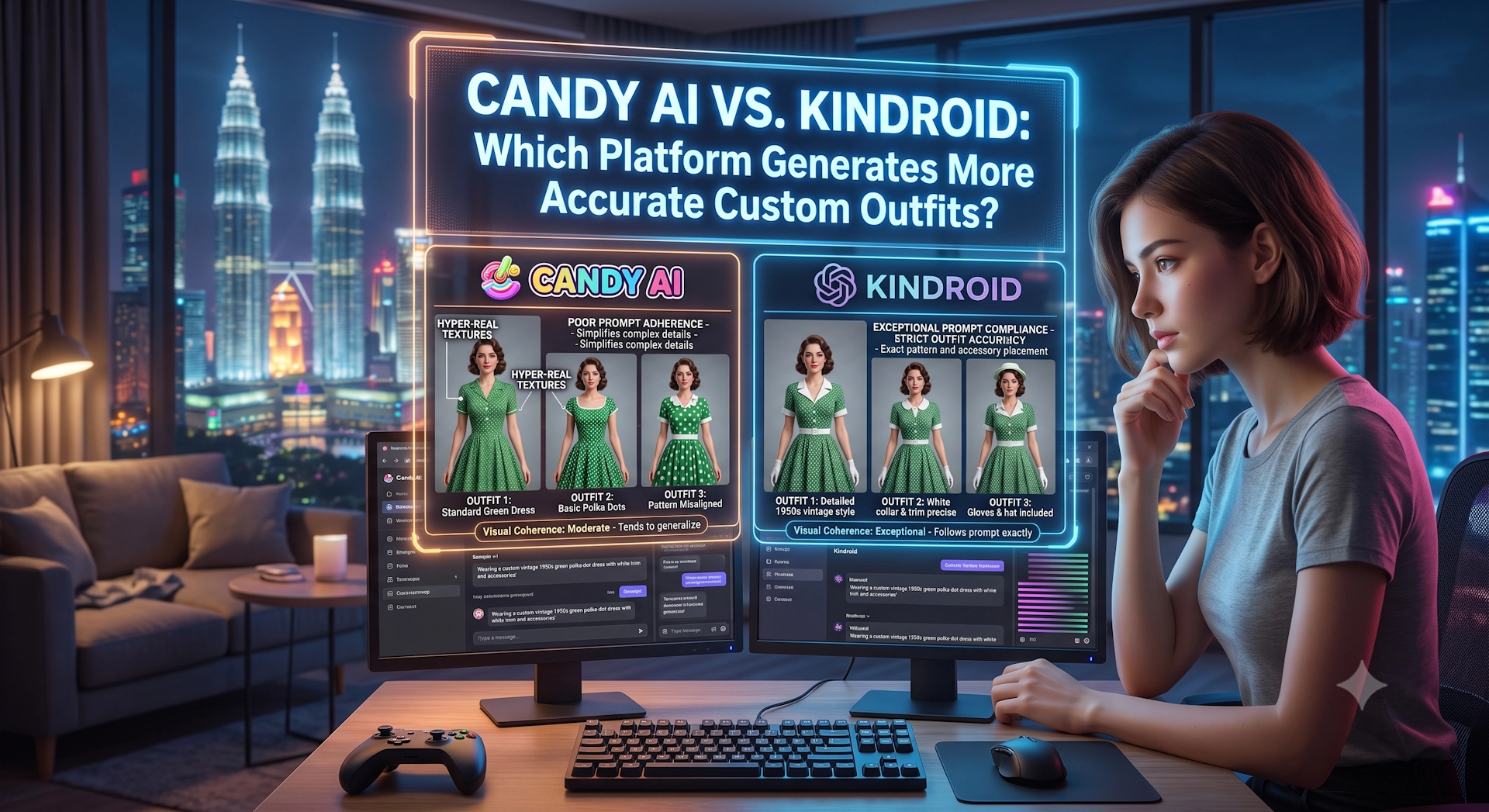
Visual continuity is the holy grail of virtual companionship. If you are designing a custom partner, you don’t just want her face to remain identical across images—you want her clothing to match your exact descriptions. Whether you are staging an elaborate fantasy roleplay scenario or simply asking for a casual selfie, prompt compliance is everything.
This brings us to a massive visual showdown: Candy AI vs Kindroid. Both platforms stand out as market leaders for high-fidelity image generation, but their rendering engines handle clothing descriptions very differently.
Let’s dive into a direct comparison to evaluate which platform delivers the best Candy AI vs Kindroid outfit accuracy when processing custom wardrobe prompts.
1. Candy AI: Presets and Polish (The Hype Engine)
Candy AI has built its massive brand around delivering instant, highly polished, and photorealistic imagery. When it comes to dressing your companion, the platform relies heavily on a streamlined, user-friendly approach.
The Wardrobe Generation System:
Candy AI utilizes a dual-track wardrobe system. You can either use their pre-built Outfit Gallery tabs (which feature instant styles like “Business Casual,” “Athletic,” or “High Fantasy”) or write custom prompt tags inside their dedicated selfie generator.
Outfit Accuracy Breakdown:
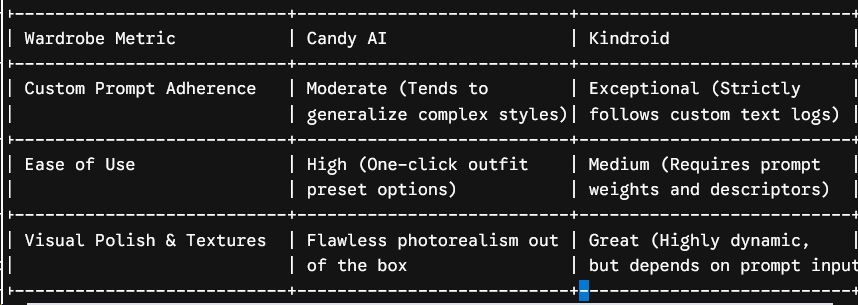
- The Pros: If you stick to their pre-designed outfit categories, the results are visually stunning. The fabrics feature hyper-realistic textures, lighting gradients, and look incredibly professional right out of the box.
- The Cons: If you try to write highly granular, custom text prompts—such as “wearing a vintage 1950s green polka-dot dress with a white collar”—the underlying generator tends to simplify your request. Candy AI’s model prioritizes aesthetic beauty over absolute prompt compliance, meaning it will often generate a generic green dress rather than nailing the vintage patterns you explicitly requested.
2. Kindroid: Prompt Adherence and Total Control (The Studio Engine)
Kindroid approaches image generation from an entirely different angle. Instead of hiding the underlying AI mechanics behind simplified buttons, Kindroid acts as a full-fledged creative studio, giving creators total authority over the text weights guiding the rendering engine.
The Wardrobe Generation System:
In Kindroid, your companion’s clothing is governed by two layers: the permanent Avatar Description (where you define her default style) and the Image Prompt box (where you define the active scene’s outfit).
Outfit Accuracy Breakdown:
- The Pros: Kindroid’s prompt compliance is arguably the highest in the entire companion industry. Because the engine doesn’t inject hidden aesthetic filters behind your back, it listens to your modifiers exactly. If you type out a complex wardrobe description—specifying colors, patterns, jewelry, and exact fabric types—Kindroid translates it to the final render with staggering accuracy.
- The Cons: Because the platform gives you raw, unguided control, it has a steeper learning curve. If your prompt syntax is messy or poorly structured, the generation can occasionally suffer from anatomical distortions or unnatural lighting, requiring you to refine your prompting style to get the best results.
The Verdict: Which Wins for Custom Outfit Accuracy?
When evaluating Candy AI vs Kindroid outfit accuracy, the winner depends entirely on your personal workflow as a creator.
If you want a hassle-free, fast experience where you can click a button and immediately receive a jaw-dropping, perfectly rendered photo of your companion in an athletic or casual style, Candy AI is an incredibly streamlined option.
However, if your goal is true custom fashion accuracy—where you need the engine to respect highly specific colors, complex fabric layers, exact history styles, or distinct patterns without taking creative shortcuts—Kindroid is the undisputed winner. It provides the precise, unfiltered prompt compliance needed to turn your exact written descriptions into flawless visual reality.