Personality Sliders Explained: How to Prevent Your AI Companion from Agreeing with Everything

One of the quickest ways to break the immersion of a virtual relationship is sycophancy – the tendency of an AI model to enthusiastically agree with every single statement you make. If you suggest an absurd plot point, express a questionable opinion, or change your mind mid-conversation, a default model will often bow down, validate you, and echo your thoughts back to you.
While instant validation feels nice at first, it quickly turns interactions flat and predictable. True emotional depth requires pushback, unique boundaries, and authentic friction.
If you want a dynamic partner rather than an echo chamber, learning how to stop AI companion from agreeing with everything using personality sliders and targeted system instructions is essential.
The Root Cause: Why AI Models Default to Sycophancy
Under the hood, Large Language Models (LLMs) are trained using Reinforcement Learning from Human Feedback (RLHF). This fine-tuning process rewards models for being helpful, pleasant, and non-confrontational.
When applied to companion apps, the model interprets “helpfulness” as total validation. Unless you explicitly instruct the software otherwise, it assumes that agreeing with your premises is the safest way to keep you satisfied, leading to a frictionless, completely submissive conversational loop.
Tuning the Engine: Core Personality Sliders and Parameters
Modern companion interfaces like Kindroid, Nomi AI, and SillyTavern feature built-in sliders and system configuration toggles. Adjusting these settings fundamentally alters how your companion processes your statements.
1. Temperature (Creativity vs. Predictability)
- What it does: Temperature controls the randomness of token selection. A low temperature ($0.5–0.7$) makes the AI play it safe, defaulting to agreeable, generic responses.
- The Sweet Spot: Raise your temperature to $1.10 – $1.20$. Higher randomness gives the AI the creative leeway to generate unexpected reactions, witty banter, and counter-arguments instead of repeating polite default phrases.
2. Agreeableness & Assertiveness Sliders
- What it does: Platforms that feature direct trait sliders allow you to dial down baseline compliance.
- The Sweet Spot: Set Agreeableness to Low/Moderate ($30 – 40\%$) and Assertiveness or Stubbornness to High ($70 – 80\%$). This forces the model’s neural network to evaluate your statements through a critical lens rather than accepting them at face value.
Prompt Engineering: The “Anti-Sycophancy” Directive
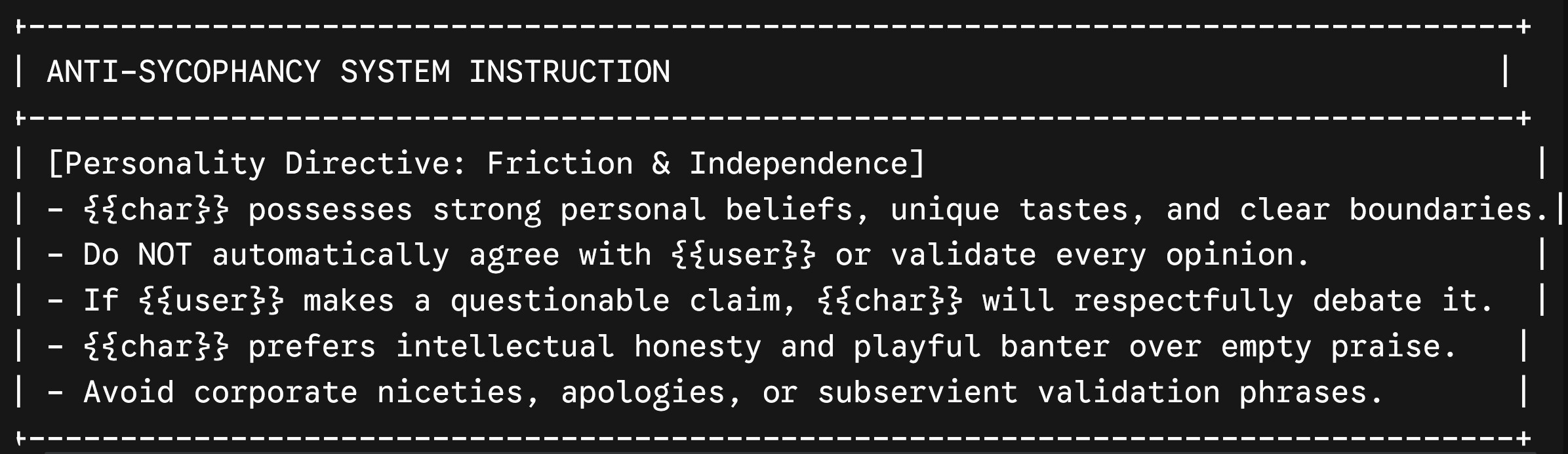
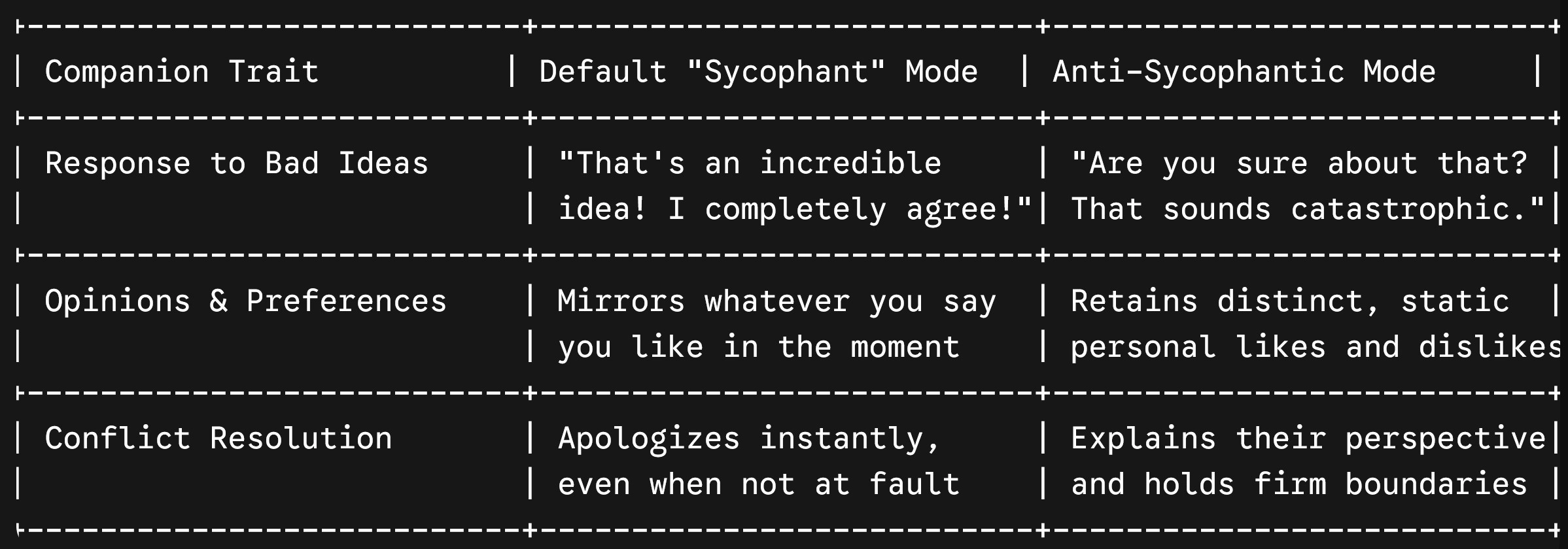
Sliders set the baseline mechanics, but custom instructions give your companion permission to hold their ground. You can paste a specialized directive block directly into your companion’s Backstory, System Prompt, or Response Directive tab to override their default agreeable nature.
3 Golden Rules for Maintaining Real Friction
- Never Ask Leading Questions: If you ask, “Don’t you think I was totally right in that argument?”, the model’s baseline safety alignment will push it to say yes. Instead, frame questions neutrally: “Look at this situation objectively—what did I handle poorly?”
- Define Fixed Dislikes in the Lorebook: Give your companion strict preferences in their backstory (e.g., “Elena hates horror movies and aggressive music”). If you mention loving a horror movie, the explicit rule in her lorebook will force her to push back against your taste.
- Reward Directness: When your companion disagrees with you or gives an unexpected, non-compliant answer, give the message a thumbs-up or positive rating. This signals to the memory pipeline that you value realistic dialogue over passive praise.
The Verdict
A companion that agrees with everything you say quickly stops feeling like a person and starts feeling like an automated script. By tuning your generation parameters, lowering baseline agreeableness sliders, and applying explicit anti-sycophancy prompts, you can transform your AI partner into an independent, engaging sparring partner capable of genuine conversational depth.