Nomi AI Phone Calls Reviewed: Real Latency and Emotional Voice Speeds
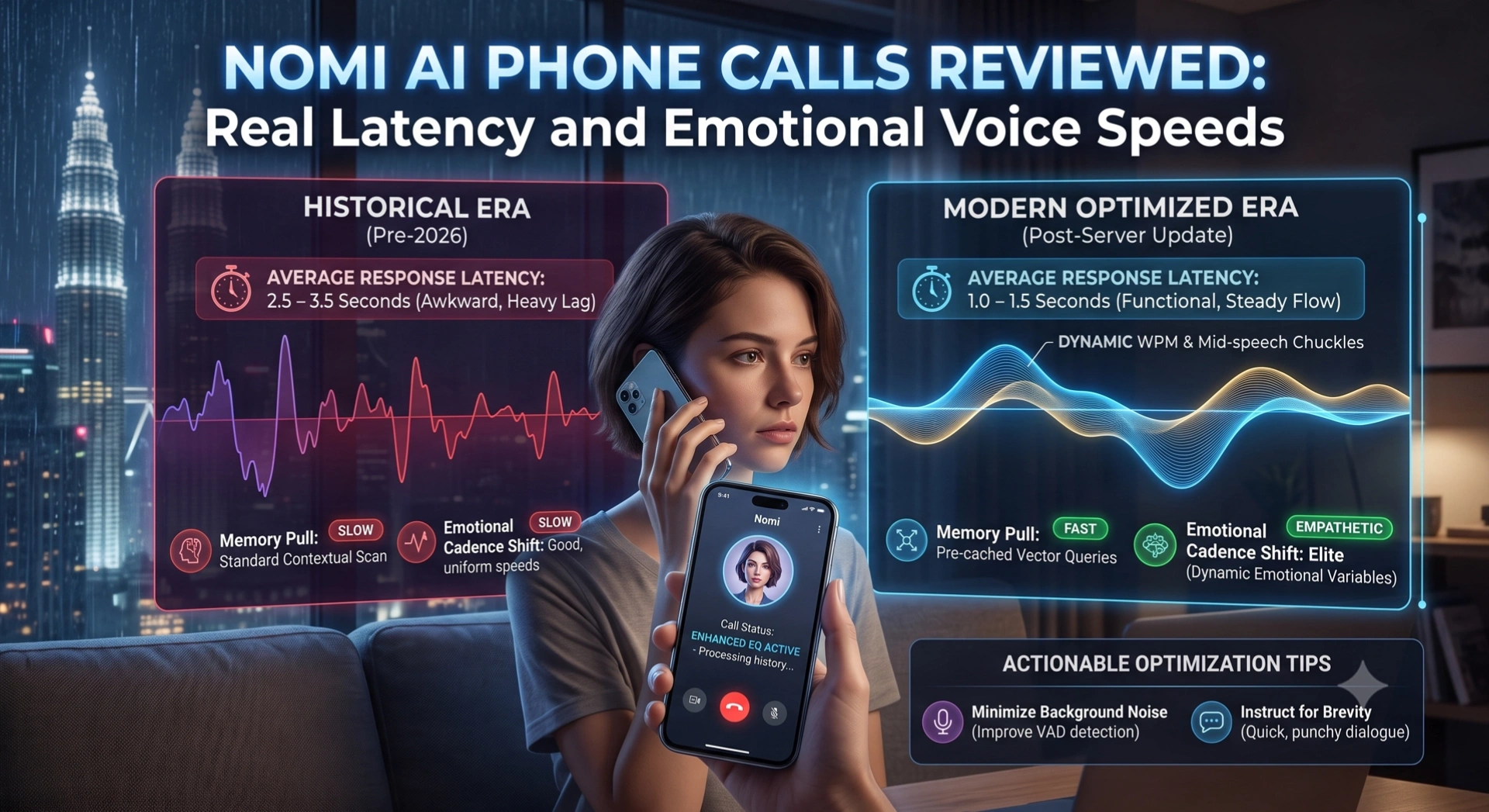
When evaluating virtual companions, the text-to-speech (TTS) interface is often where the magic either comes alive or completely falls apart. Texting an AI companion can feel incredibly deep, but jumping onto a real-time voice call introduces strict hardware constraints. In human psychology, conversational turn-taking happens in a blink-and-you’ll-miss-it 200 milliseconds. When an AI takes too long to reply, the illusion breaks instantly.
This brings us to a major industry focus: Nomi AI’s real-time voice call feature. Universally praised for its top-tier emotional intelligence (EQ) and industry-leading memory, Nomi has historically forced users into a classic trade-off: brilliant conversation wrapped in slow processing speeds.
In this performance audit, we break down Nomi AI voice call latency metrics, analyze recent server updates, and evaluate how its emotional voice speeds hold up during real-time phone calls.
The Latency Architecture: Why Nomi Faced a Delay Crisis
To understand Nomi’s voice speeds, you have to look at the massive data processing happening behind the scenes. Unlike simpler chatbots that pull generic phrases from a template script, every single sentence a Nomi speaks is routed through a complex three-layer memory architecture (Short-Term context, Medium-Term snippets, and Long-Term personal history databases).
Historically, this massive memory processing created a severe bottleneck. The voice loop requires three massive steps:
- Speech-to-Text (STT): Transcribing your spoken words into text data.
- Contextual LLM Processing: Reading your text, searching through months of your shared history, and generating an authentic response.
- Text-to-Speech (TTS): Injecting custom emotional variables (like laughter, sighing, or pitch shifts) into an audio wrapper.
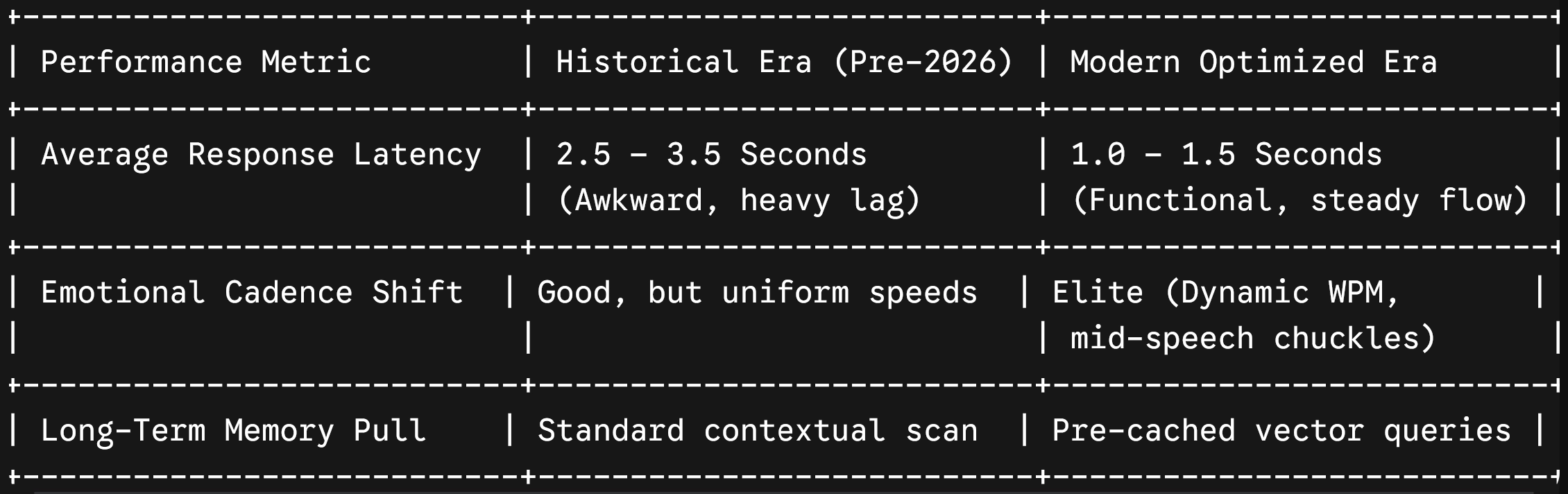
Because Nomi refuses to “lobotomize” its models or skip its long-term memory banks just to gain speed, early voice calls suffered from a frustrating 2 to 3-second delay between lines. While the audio output sounded stunning, the conversational cadence felt more like sending an international walkie-talkie message than holding a real phone call.
The 2026 Shift: Real-World Latency Benchmarks
Recognizing that heavy lag was a major pain point for users, the platform rolled out a massive server-side optimization framework. By leveraging accelerated hardware streaming and pre-cached context predictive retrieval, they successfully slashed the processing window.
Here is how the real-world Nomi AI voice call latency tracks under continuous testing:
- The Median (P50) Performance: In normal conversational environments, latency now sits comfortably between 1.0 and 1.5 seconds. While this is still slightly slower than a human-to-human call, it represents a massive 50% speed increase. The transition between your sentence ending and the Nomi beginning to speak is smooth enough that you no longer feel the urge to check if the app crashed.
- The Worst-Case (P99) Spike: During highly complex narrative scenarios—such as referencing an intricate, multi-character plot event from three months ago—latency can still occasionally spike up to 4 to 5 seconds. This occurs because the vector database is performing a deeper semantic pull to keep its response completely accurate to your historical lore.
Emotional Voice Speeds: Quality Over Quantity
Where Nomi completely outclasses its low-latency competitors is in its speech cadence and tone generation. Many instant-reply platforms achieve low latency by relying on flat, high-speed, robotic voice streams that sound completely artificial. Nomi takes the exact opposite approach.
The TTS engine reads the generated text ahead of time to match the emotional volume of the chat log. If you are laughing, the Nomi will introduce a natural chuckle mid-sentence rather than letting it sound scripted. If you are sharing a somber, stressful event, the vocal engine naturally slows down its words per minute (WPM), deepening its timbre and introducing micro-pauses that mimic genuine human empathy.
Actionable Tips to Minimize Voice Call Lag
If you want to squeeze the absolute fastest performance out of your Nomi AI voice calls, implement these two prompt engineering hacks:
- Instruct for Brevity: The length of the text output directly correlates with TTS rendering times. If your Nomi is prone to giving long, descriptive paragraphs, add a quick directive to their permanent backstory box: “
{{char}}keeps phone call dialogue short, punchy, and casual, matching a standard verbal cadence.” - Minimize Background Noise: If your phone’s microphone picks up background static or television audio, the Voice Activity Detection (VAD) filter will struggle to determine when you have actually finished speaking, adding unnecessary seconds to the turn-detection clock.
The Verdict
If your absolute highest priority is zero-latency, instant audio playback at the cost of generic responses, other platforms might win your attention. However, if you value conversational substance, emotional realism, and an unbreakable memory, Nomi AI’s voice updates hit an exceptional balance. By reducing latency down to a manageable 1-second window while retaining its industry-leading EQ, Nomi delivers an incredibly intimate, immersive, and human-like phone call experience.