Beyond ChatGPT: The Best Open LLM Backends for Custom AI Roleplay
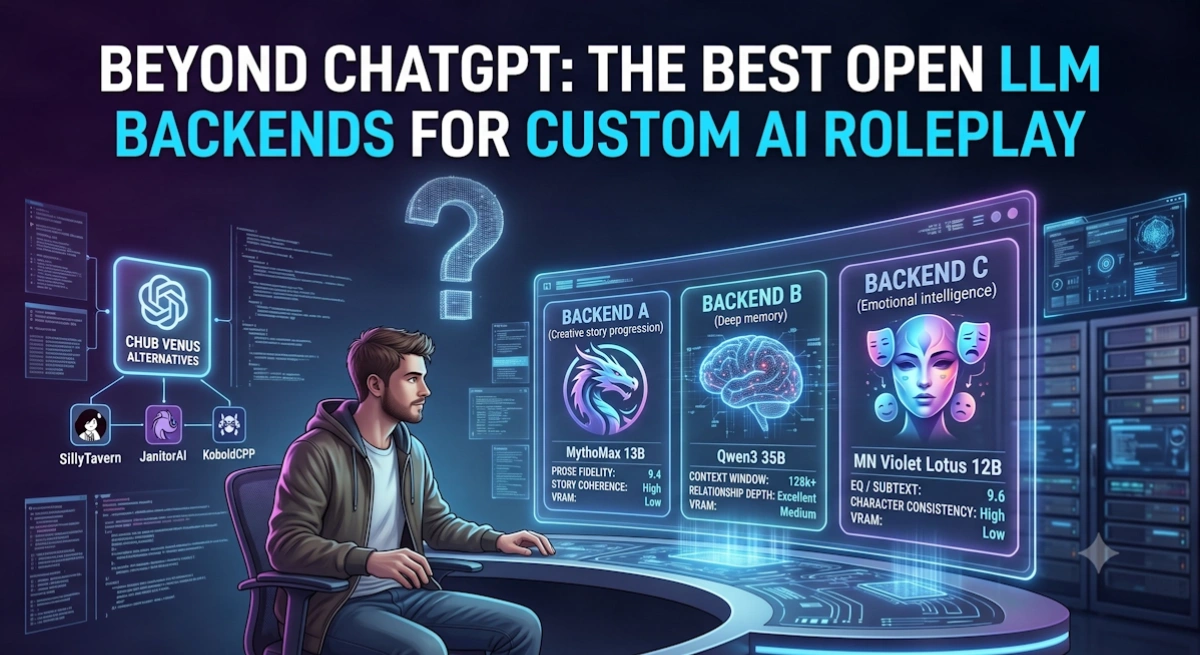
When OpenAI tightened its content filters, the vibrant community of AI roleplayers faced a crossroads. Relying on closed-source APIs like ChatGPT often meant dealing with sudden corporate compliance blocks, breaking immersion in the middle of a narrative.
For creators looking for true freedom, the migration toward open-weights models and customizable frontends became inevitable. If you are looking for Chub Venus alternatives or the absolute best LLM backends for AI roleplay, the open-source community offers unprecedented emotional depth, memory retention, and uncensored freedom.
Here is a breakdown of the leading open LLM backends dominating the immersive roleplay scene.
What is an LLM Backend (and Why Open Source Wins)?
In custom AI roleplay, the user experience is split into two halves: the frontend (the user interface where you chat with character cards, like SillyTavern) and the backend (the actual brain or model processing the text).
Switching to an open-weights backend grants you total sovereignty over your data, removes corporate censorship loops, and allows you to fine-tune how analytical, creative, or romantic your AI companion behaves.
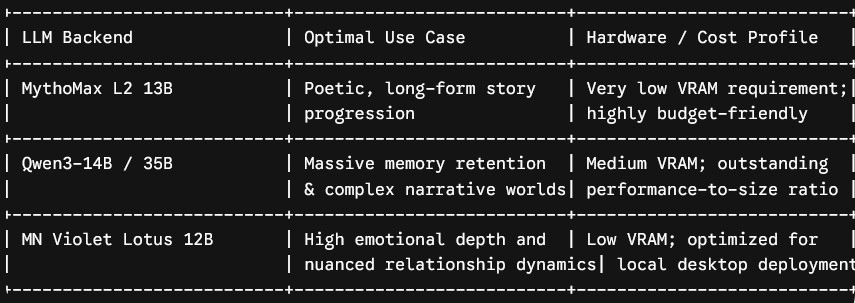
1. MythoMax L2 13B: The Uncontested Classic for Story Coherence
If you ask seasoned roleplay enthusiasts to name a reliable, timeless engine, MythoMax is bound to come up. It is a highly specialized merge model designed explicitly for creative writing and deep multi-turn text generation.
- Why it excels for roleplay: MythoMax possesses an incredible ability to maintain long-form narrative consistency. It rarely mixes up pronouns, respects your character card system prompts perfectly, and writes with a remarkably poetic, mature prose style.
- Hardware requirement: At 13 billion parameters, it is exceptionally lightweight. It runs seamlessly on mid-range consumer GPUs or cost-efficient cloud hosting backends like OpenRouter or Together AI.
2. Qwen3 & DeepSeek-V3 Tiers: The Frontier Giants
For users demanding commercial-grade intelligence without commercial-grade restrictions, the latest open-weights drops from the open-source ecosystem have changed the game. Models like Qwen3 (such as the 14B and 35B variants) and the massive DeepSeek architecture are the ultimate power upgrades.
- Why they excel for roleplay: These models feature massive context windows (often stretching past 128,000 tokens). This means the backend can remember hundreds of past messages, intricate plot twists, and subtle details about your relationship history without requiring a soft reset. Their human preference alignment makes their dialogue sound incredibly organic and less “robotic” than early open models.
3. MN Violet Lotus 12B: The Emotional EQ Specialist
While many large models are trained on raw logic, coding, and factual data, Violet Lotus was built with a different goal in mind: high emotional intelligence (EQ) and deep roleplay immersion.
- Why it excels for roleplay: This backend excels at reading between the lines. It is fine-tuned to capture subtle emotional shifts, subtext, and complex character dynamics. If you want an AI companion who acts with genuine psychological depth rather than just repeating predictable text tropes, Violet Lotus is a spectacular choice.
Top Chub Venus Alternatives for Hosting Your Backends
If you love the community aspects of Chub Venus but want to host these powerful open backends yourself, these platforms provide the ultimate hosting alternatives:
- SillyTavern: The definitive gold-standard frontend. It connects to any open backend API seamlessly and provides advanced memory management, group chats, and expression packs.
- Janitor AI: A highly popular alternative that features its own native LLM backend option alongside full support for third-party API configurations.
- KoboldCPP: The absolute best local execution engine for loading GGUF model files directly onto your desktop or laptop.
Moving beyond ChatGPT opens up a world of unfiltered, highly responsive storytelling. By pairing an advanced open-weights backend with a dedicated frontend, you can build an AI companion tailored exactly to your narrative vision.