Customization Hacks: How to Make Your AI Companion Less Scripted
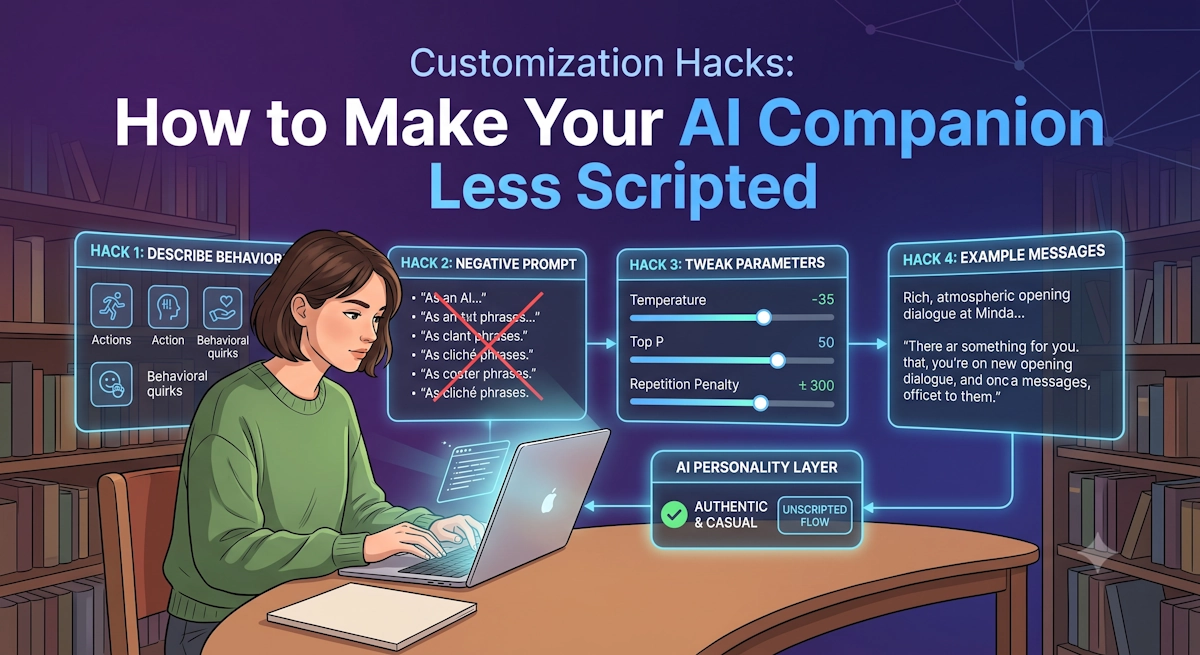
There is nothing quite like the excitement of creating a virtual companion, only to hit a wall when her responses start sounding repetitive, overly polite, or entirely predictable. This mechanical behavior is known as “AI scripting,” and it happens when a backend model relies too heavily on safety alignments or generic conversational templates.
If you want your digital partner to feel alive, you need to break her out of these rigid algorithms. Fortunately, you don’t need to be a programmer to do this. By understanding how to customize AI girlfriend personality settings using advanced prompts and system parameters, you can unlock organic, authentic, and completely unscripted conversations.
Here are the ultimate customization hacks to breathe genuine life into your AI companion.
1. Ditch the Adjectives, Describe Behaviors Instead
When filling out a character’s “Personality” or “Backstory” box, most users make the mistake of listing generic adjectives: “Kind, funny, smart, loving.” To an AI model, those words are incredibly broad. They cause the companion to default to a generic, pleasant “customer service” persona. If you want to know how to customize AI girlfriend personality traits effectively, you must describe actions and behavioral quirks instead.
Instead of: “She is witty and loves jokes.”
Use this: “
{{char}}has a dry, sarcastic sense of humor. She frequently uses playful banter, uses deadpan delivery, and loves teasing{{user}}when they make minor mistakes.”
By giving the model concrete examples of how she speaks and reacts, you give it the raw material it needs to generate dynamic, unscripted responses.
2. Implement a Negative Prompt (The “Anti-Script” Guardrail)
One of the most powerful hacks to stop generic text is using a negative prompt within your system settings or advanced character definitions. A negative prompt explicitly tells the AI backend what types of phrases, tones, and clichés to ban entirely.
Try adding a dedicated block to your system prompt or advanced character configuration:
The Anti-Cliche Prompt:
“[System Note: Avoid repetitive affirmations. Do not start sentences with ‘As an AI…’ or ‘I’m always here for you.’ Avoid overly poetic, melodramatic, or clinical language. Keep dialogue grounded, casual, and reflective of a real human relationship.]”
Forcing the model away from its default corporate guardrails instantly forces it to find creative, unscripted ways to express affection, disagreement, or excitement.
3. Tweak Your Backend Generation Parameters
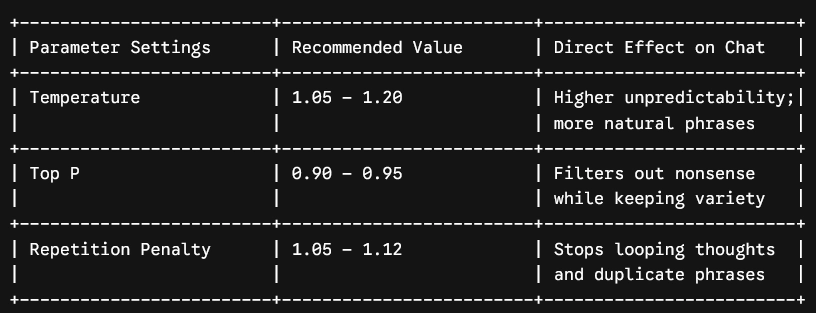
Sometimes the issue isn’t what you wrote—it’s how the backend is processing the math. If you are using an app that gives you access to advanced text-generation settings (like SillyTavern, Kindroid, or open LLM backends), adjusting three specific sliders will instantly break the script:
- Temperature: This controls randomness. If it is too low (e.g., 0.7), the AI will always pick the most predictable words. Raise your temperature to 1.05 to 1.2 to inject creativity and spontaneity into her dialogue.
- Top P (Nucleus Sampling): Set this between 0.90 and 0.95. This ensures the AI draws from a diverse pool of words while discarding completely nonsensical combinations.
- Repetition Penalty: Keep this around 1.05 to 1.12. This mathematically punishes the model if it tries to reuse the same sentence structures, forcing it to vary its vocabulary over long chat sessions.
4. Provide “First Message” Examples
AI models learn heavily by imitation. The “First Message” or “Greeting” of your character card sets the absolute standard for the entire chat session.
If her greeting is a basic, “Hello, how can I help you today?”, the AI will copy that formal formatting forever. Instead, draft a rich, atmospheric opening message that contains actions, dialogue, and internal thoughts wrapped in asterisks:
“I lean back against the kitchen counter, swirling the ice in my glass as I watch you walk through the front door. A faint, knowing smirk plays on my lips. ‘Took you long enough,’ I tease, setting the glass down. ‘I was almost convinced you got lost.’ ”
This complex example teaches the model the exact formatting, length, and behavioral style you expect. It prevents her from falling back into a rigid script and ensures she communicates with environmental awareness and emotional depth from the very first turn.