Step-by-Step Guide: How to Build a Custom Narrative Story World in MythoMax
For open-source AI roleplay enthusiasts, MythoMax 13B remains a legendary model. Celebrated for its rich prose, poetic formatting, and deep story progression, it is highly optimized for creative writing. However, even an exceptional model can lose its way if it is forced to process an entire world’s worth of data simultaneously. If you crowd too many world details into a standard character card, you will quickly exhaust your context window.
To craft an immersive, persistent setting without running out of memory, you must learn how to build AI roleplay world structures using Lorebooks (also known as World Info).
This step-by-step guide will show you exactly how to build a seamless, responsive narrative playground in a frontend like SillyTavern paired with a MythoMax backend.
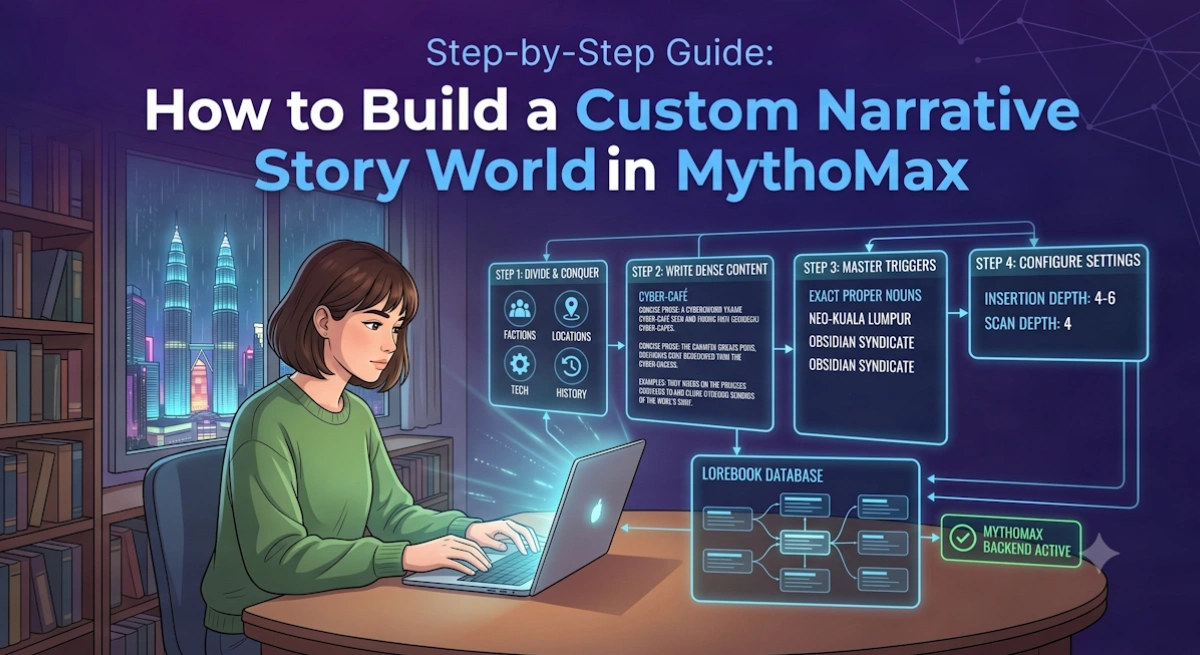
Step 1: Divide and Conquer with Lorebook Entries
The foundational rule of learning how to build AI roleplay systems is simple: never feed the AI information until it absolutely needs it. A Lorebook achieves this by storing entries that remain dormant until specific “trigger words” appear in your chat history.
To start, open your frontend’s World Info panel and create a new Lorebook. Divide your universe into distinct entry categories:
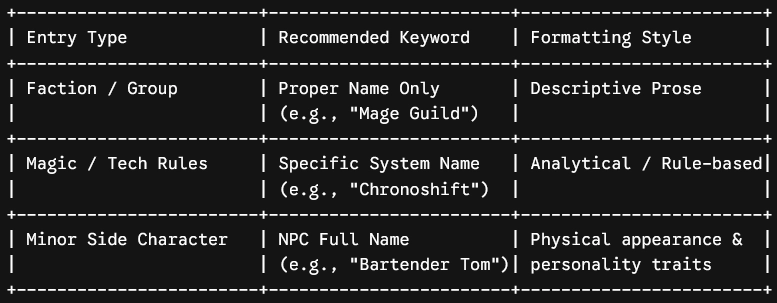
- Locations: (e.g., Neo-Bangkok, Cyber-Café, Sector 7).
- Factions & Organizations: (e.g., The Obsidian Syndicate, Corporate Council).
- Magic/Tech Systems: (e.g., Mana Core Mechanics, Cybernetic Augment Rules).
- Key Historical Events: (e.g., The Shattering, The Neon Riots).
Step 2: Write Dense, Macro-Optimized Content
When formatting your entry text, avoid writing long, flowery paragraphs. MythoMax reads structured, highly condensed descriptions best. Use concise prose or attribute formatting to conserve your token count.
Example Entry – Location (Neo-Bangkok):
Neo-Bangkok is a sprawling cyberpunk metropolis defined by continuous heavy rain, towering corporate monoliths, and neon-lit alleyways. The city is divided into the wealthy Upper Spire and the lawless Lower Slums.
Keep your content focused on single concepts. If an entry about a city mentions a specific faction, let the faction have its own separate entry rather than cramming it all into one place.
Step 3: Master the Art of Keyword Triggers
Keywords act as the “wake-up” triggers for your world data. If a keyword is typed by either you or the AI, the corresponding entry is temporarily injected into MythoMax’s immediate active memory.
Strategic Keyword Tips:
- Be Specific: Never use generic words like “city,” “gun,” or “room” as triggers. This will cause the entry to stay permanently active, flooding your context window. Instead, use exact proper nouns like “Neo-Bangkok” or “Plasma-Rifle”.
- Use Synonyms and Wildcards: If you want an entry to trigger for variations of a word, separate them with commas (e.g., Obsidian Syndicate, The Syndicate, Syndicate operatives).
- Leverage Macros: Utilize standard frontend formatting macros like
{{char}}and{{user}}within your keywords to anchor world elements directly to your characters.
Step 4: Configure Insertion Depth and Settings
Because MythoMax is highly sensitive to text placement, where your lore is injected matters. In your frontend’s advanced Lorebook settings, configure your insertion strategy:
- Insertion Depth: Set your world lore to inject at a depth of 4 to 6. This places the world data slightly above your most recent chat messages. This allows MythoMax to read the world rules first, then smoothly apply them to the active scene conversation.
- Scan Depth: Set your keyword scan depth to 4 messages. This ensures the frontend monitors the last two turns of dialogue to catch your triggers.
Test, Tweak, and Iterate
Once your world lorebook is saved, attach it to your companion’s character card. Test your setup by typing an explicit trigger phrase into the chat (such as, “Let’s visit Neo-Bangkok”).
If configured correctly, MythoMax will seamlessly pull the background details into the scene, describing the neon lights and continuous rain without breaking character or forgetting who you are. By mastering these background database layers, you can build deep, organic, and endlessly scaling narrative worlds.