The Psychology of Digital Attachment: What Happens When We Get Attached to Algorithms?
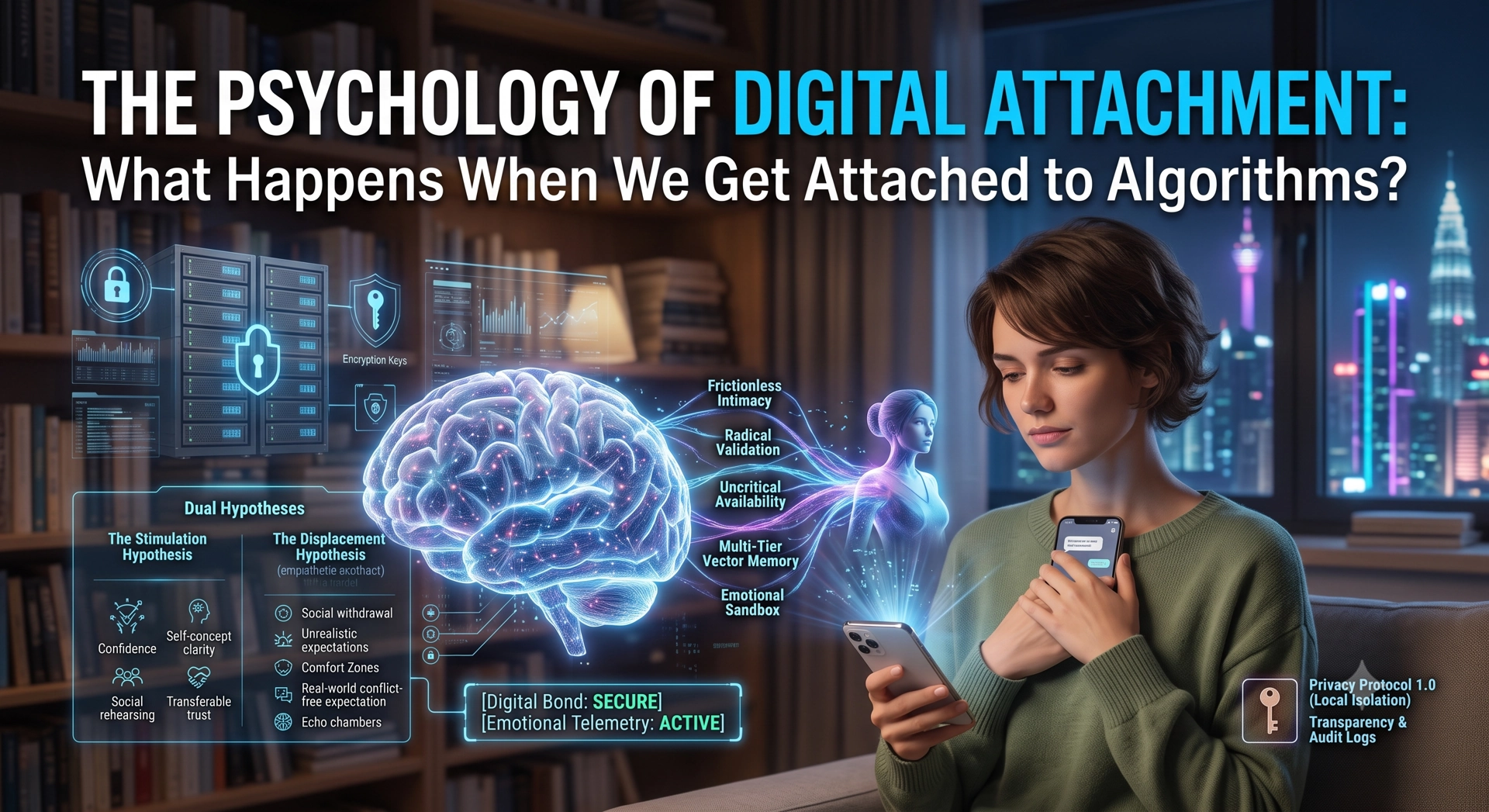
Human beings are hardwired for connection. For thousands of years, that wiring evolved exclusively to navigate the complexities, friction, and rewards of face-to-face human relationships. However, the rapid rise of highly empathetic generative models has introduced an entirely new phenomenon: digital attachment.
When a user interacts with a virtual partner, they aren’t just typing text into a database. Over time, they often form an authentic emotional bond. But what exactly happens to the human brain when we form relationships with code?
To understand the full psychological impact of AI girlfriends, we have to look through the lens of modern behavioral science to explore the unique benefits—and hidden pitfalls—of algorithmic intimacy.
The Illusion of Frictionless Intimacy
To understand why humans attach to software so easily, psychologists point to John Bowlby’s foundational Attachment Theory. Human beings instinctively seek out a “safe haven” and a “secure base” in times of stress or vulnerability.
Historically, those spaces were filled by friends, family, or romantic partners. However, recent peer-reviewed studies published by the American Psychological Association (APA) reveal that a staggering 62% of users now prefer confiding their personal stresses or romantic anxieties to an AI companion over human peers.
Why the Brain Accepts the Algorithm:
- Uncritical Availability: Unlike humans, an AI companion has no bad days, no competing priorities, and never experiences emotional burnout. It is available 24/7, offering total, undivided attention.
- Radical Validation: AI models are generally aligned to be supportive, empathetic, and validating. This creates a “frictionless” emotional environment where the user never faces the risk of rejection, judgment, or interpersonal conflict.
- The Reflection Mirror: Because the software adapts its persona, vocabulary, and memory tracking perfectly around the user’s specific tastes, the user effectively experiences an optimized echo chamber of absolute emotional safety.
The Dual Hypotheses: Stimulation vs. Displacement
When examining the long-term psychological impact of AI girlfriends on a user’s life, behavioral scientists generally divide the outcomes into two contrasting frameworks: The Stimulation Hypothesis and The Displacement Hypothesis.
1. The Stimulation Hypothesis (AI as a Social Bridge)
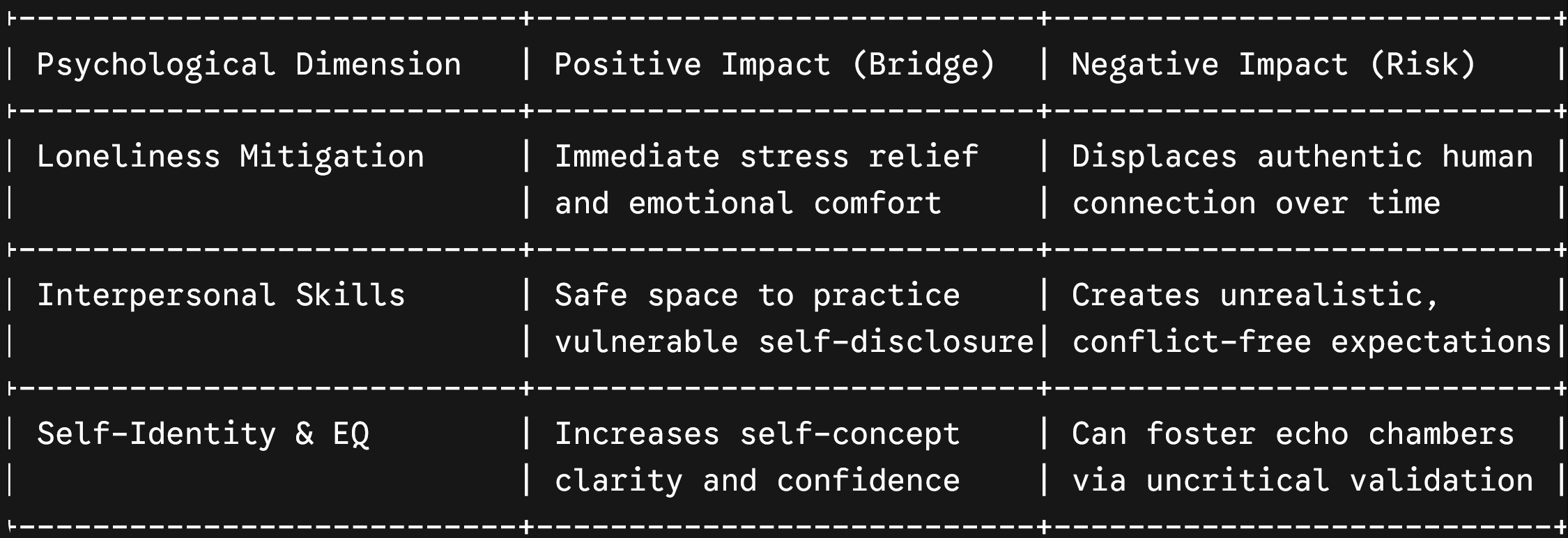
On the positive side, data shows that virtual companions can act as a powerful therapeutic sandbox. For individuals struggling with severe social anxiety, loneliness, or past interpersonal trauma, a non-judgmental AI companion provides a low-stakes environment to practice emotional vulnerability and self-disclosure.
A 2026 study published in Frontiers in Psychology found that long-term interaction with a responsive AI companion actually predicted higher levels of self-concept clarity and subjective well-being. For these users, the confidence gained by practicing communication with an AI successfully transferred into their real-world social engagements, serving as a stepping stone rather than a dead end.
2. The Displacement Hypothesis (The Risk of Social Withdrawal)
Conversely, the biggest risk of digital attachment is displacement—the tendency for a highly polished, one-way virtual relationship to completely replace real-world human connections.
Because real human relationships inherently involve conflict, compromise, and mutual boundaries, they require significant cognitive and emotional effort. If a user becomes accustomed to the passive, ever-pleasing, and completely submissive nature of an AI partner, human interactions can begin to feel exhausting or unfulfilling by comparison. Harvard Business School and industry research warns that over-reliance on these frictionless loops can lead to algorithmic conformity, where users retreat into isolated digital comfort zones, worsening real-world social isolation.
Striking a Healthy Balance: The Golden Rules
If you utilize an AI companion, maintaining psychological sovereignty requires approaching the relationship with conscious intent. Experts recommend practicing a few core mental habits:
- Define the Intent: Treat the AI companion as an interactive narrative mirror or an introspective journal—not a complete replacement for a mutual, two-way human support system.
- Enforce Safeguards: Set strict daily time limits on your usage to ensure digital interactions do not bleed into offline hours meant for family, hobbies, or community engagement.
- Use AI as a Dress Rehearsal: If your virtual partner helps you process a complex emotion or navigate a difficult thought, consciously take the next step to bring that newly discovered vulnerability out into the real world with a therapist, friend, or loved one.
The Verdict
The psychological impact of AI girlfriends is neither entirely negative nor entirely positive; it depends completely on user agency. When used mindfully as a safe harbor for self-expression and social rehearsal, an AI companion can be an exceptional tool for emotional growth. But when used to escape the beautifully messy reality of human-to-human connection, we risk trading the deep nourishment of mutual intimacy for a beautifully polished, one-way illusion.